

The best dog age calculator for most owners is PetName's: two inputs, four size classes, no ads and no sign-up. Dogster does more, Omni Calculator and GIGAcalculator cite the research, and one popular tool gave the same answer for a toy poodle and a Great Dane. We typed the same ages into six calculators in October 2026, read the AKC's explainer alongside them, and compared what came back. Full disclosure: we build PetName, so we've tried to keep the criteria measurable and to say where others beat us.
Key Takeaways
What a dog age calculator actually is (and what it is not)
A dog age calculator turns your dog's calendar age into a rough human-equivalent age. It is a lookup, not a measurement. Nothing in it knows your dog's health, genes or lifestyle.
There are three approaches in the wild. The oldest is the "multiply by 7" rule, which the AKC, quoting the AVMA, says is wrong. The second is a size-adjusted curve: about 15 human years for the first year, about 9 for the second, then a per-year rate that depends on how big the dog is. The AKC relays the AVMA's version of this for a medium dog as 15, 9, then about 5 per year. The third is the 2020 UC San Diego epigenetic clock, human age = 16 x ln(dog age) + 31, built from DNA methylation in 104 Labrador retrievers (Wang et al., Cell Systems).
None of these is a diagnosis. A calculator can tell you that a 10-year-old giant breed is probably senior. It cannot tell you whether your dog is healthy for its age. For that, ask your vet, and see the AVMA's guide and the UC San Diego write-up for the background.
What a good calculator does well is save you the arithmetic and apply the right curve for your dog's size. That is what we compared.
How We Ranked These Dog Age Calculators
We tested the six calculators on October 17, 2026, using the same ages (3, 7 and 12 years) and each size option the tool offered. Outputs were typed into the live pages, not copied from marketing text, except PetName's (computed from its code), GIGAcalculator's (its page examples and cited formula) and the AKC's (a chart, not a calculator). Ad checks combined a raw HTML search with a headless Chromium load that recorded network hosts and ad-slot elements. We scored on seven criteria:
- Inputs you control. How many fields or choices change the result (age, months, birth date, breed, size).
- Size classes that change the number. Zero, three, four or five.
- Formula disclosed and source cited. Does the page name where the math comes from?
- Does the result actually move with size? We tested ages 3, 7 and 12.
- Ad load on first load. Ad-slot elements and ad-network hosts in a headless load.
- Pop-ups and gates. Any modal, email wall or sign-up on first load.
- Extras. Birth-date input, breed list, life stage, human-to-dog reverse.
Two caveats. A headless browser is not a real visitor, so ad counts are a floor, not a guarantee. And PawCalculator's site stopped responding late in our session, so its ad slots and pop-ups were not measured.
PetName on our criteria (our own 0-10 judgment, October 2026)
The Consult Room, a veterinary channel, explains why the old 7-year rule doesn't hold up. It is a useful watch before you trust any single number.
The Best Dog Age Calculators in 2026
Here are the seven, in the order we'd recommend them. Six are interactive calculators. The last, from the AKC, is an article with a chart, and we say so. Where a tool beats PetName on a criterion, we say that too.
1. PetName, best for a fast, ad-free size-adjusted estimate
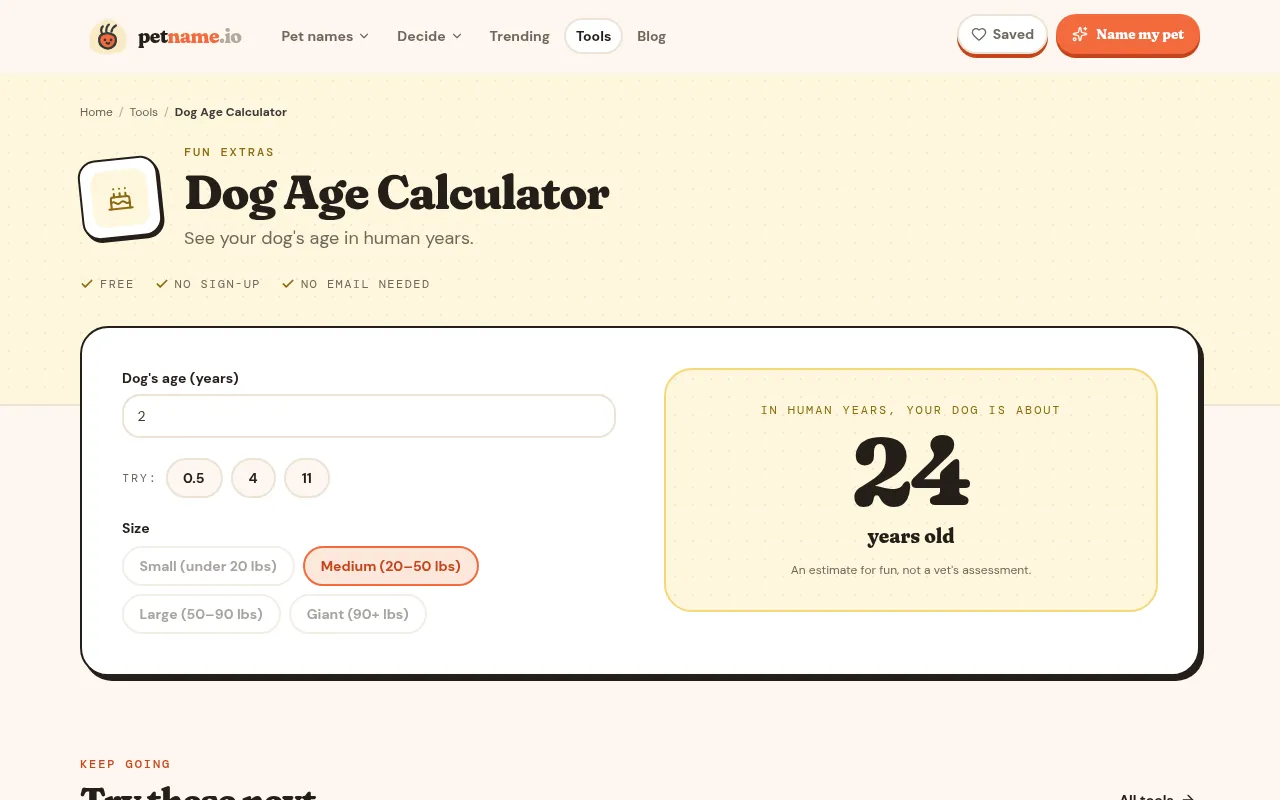
PetName's dog age calculator asks two questions: age in years (decimals allowed, 0 to 40) and a size class chip. That is the whole form. Quick-fill chips jump to 0.5, 4 and 11 years.
The four size classes are small (under 20 lbs), medium (20 to 50), large (50 to 90) and giant (90 plus). The math, from the tool's code: age times 15 up to year one, then 15 plus 9 per extra year up to two, then 24 plus a per-year rate of 4 (small), 4.5 (medium), 5.5 (large) or 7 (giant). Results keep one decimal place. Our 12-year-old giant lands at 94.
In our test the page loaded zero ad slots and no ad-network hosts, just a Google Tag Manager request. There is no sign-up and no email prompt.
The weak spots are real. There is no birth-date or months field, no breed list, no life-stage label, and no named source on the page. Its FAQ calls the curve a "widely-used estimate" without naming the AVMA or UC San Diego.
What we liked
- No ads, no pop-ups, no account
- Four size classes with a simple, readable formula
- Matches Dogster's and Omni's numbers for small dogs
Watch out for
- No birth-date, months or breed input
- No source named on the page
- No life-stage label
Best suited for
Owners who want a size-adjusted answer in about ten seconds without ads. Skip it if you need a birth-date field or a breed lookup.
2. Dogster Dog Age Calculator, best for the most features in one place
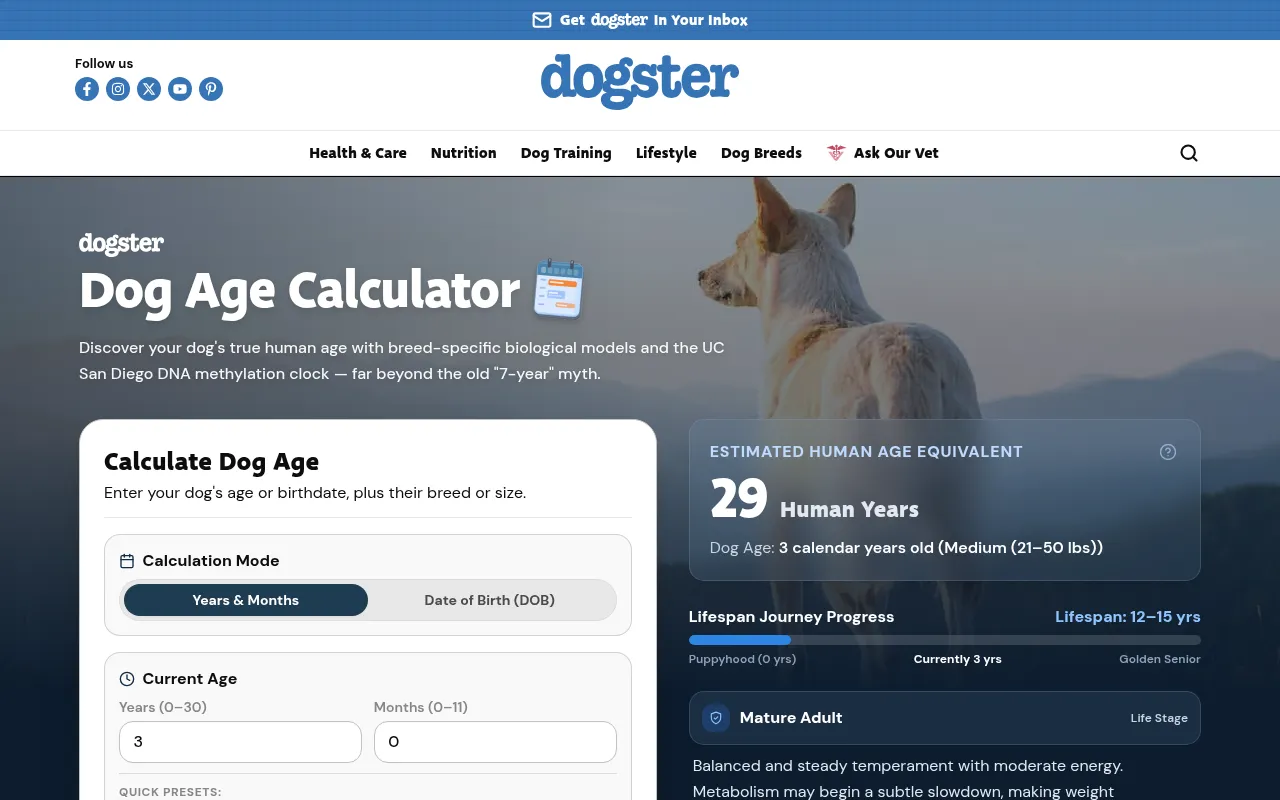
Dogster's calculator is the most complete free tool we found. It offers a Years and Months or Date of Birth toggle, years from 0 to 30, an optional search across 390+ dog breeds, and the same four size classes (small under 21 lbs, medium 21 to 50, large 51 to 90, giant 90 plus). Quick presets cover 6 months and 1, 3, 7, 10 and 14 years.
The output goes well beyond one number: a human-equivalent age, a life stage such as "Mature Adult," a lifespan range, and a separate "DNA Epigenetic Clock" figure from the UC San Diego formula (48.6, 62.1 and 70.8 at ages 3, 7 and 12). That side-by-side is genuinely useful because it shows how far the two methods can drift.
One catch: on our test, the live result box and Dogster's own chart on the same page disagreed for medium, large and giant dogs. A large 7-year-old showed 54 in the box and 50 in the chart. Dogster loaded no ad slots in our headless test, though a "Get dogster in your inbox" banner sits at the top. A plain curl request hits a Cloudflare challenge, but a normal browser loads it fine.
What we liked
- Birth date, breed list, life stage and lifespan range
- Shows the size curve and the UCSD clock side by side
- Names the UC San Diego source
Watch out for
- Result box and its own chart disagree for larger dogs
- Heavier page with more to read
Best suited for
Owners who want a life stage, a breed lookup and the DNA-clock number together. If you only want one quick figure, it is more than you need.
3. Omni Calculator, best for Labrador owners and human-to-dog conversion
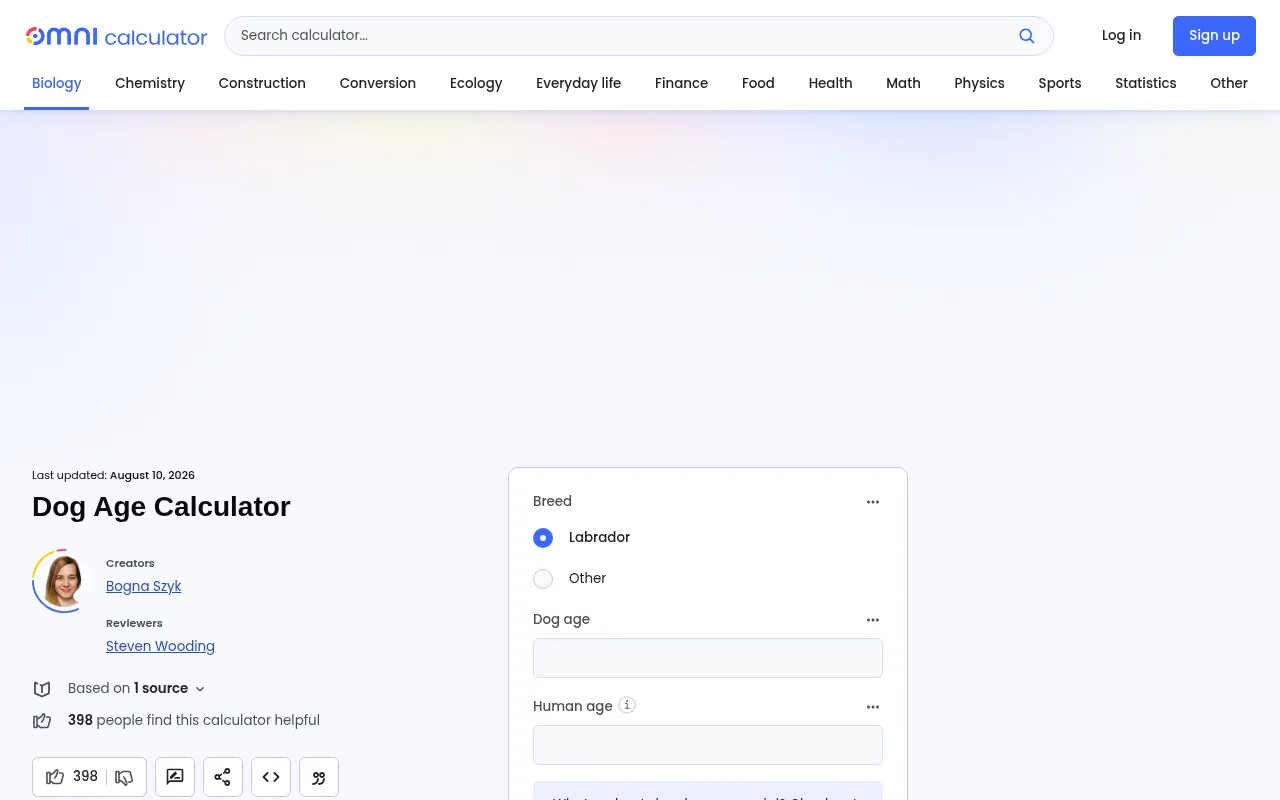
Omni Calculator's dog age tool is the only one here that runs both directions: enter a dog age to get a human age, or a human age to get a dog age. It accepts dogs 19 years old and younger.
It has a breed toggle (Labrador or Other). Labrador mode uses the UC San Diego formula, 16 x ln(dog years) + 31, from the study of 104 Labradors. Other mode asks for size, but only three classes: small (20 lbs or less), medium (21 to 50) and large (over 50). There is no giant option. Results are whole numbers: Labrador 49, 62 and 71 at ages 3, 7 and 12; Other-medium 28, 47 and 69.
The page shows a named creator (Bogna Szyk) and reviewer (Steven Wooding), "Based on 1 source," a last-updated date of August 10, 2026, and "398 people find this calculator helpful." It is free, and the calculator needs no login. Ads are present: raw HTML showed none, but a headless load made many programmatic ad requests and one ad-slot element.
What we liked
- Labrador mode uses the peer-reviewed formula
- Named creator and reviewer
- Converts human age to dog age
Watch out for
- Only three size classes, no giant
- One breed-specific mode
- Ad-supported
Best suited for
Labrador owners who want the study's formula, or anyone converting a human age into dog years. Giant-breed owners should look elsewhere.
4. PawCalculator, best for a life-stage label by size
PawCalculator's "How Old Is Your Dog, Really?" takes weight (pounds or kilograms), age in years and a size category with five options, toy through giant, auto-selected from weight. That is the most size classes of any tool here.
The page says it uses a size-adjusted curve and cross-references the UCSD formula, and it publishes a size table and a senior-threshold table (small 10 to 11 years, medium 8 to 9, large 7 to 8, giant 6 to 7). The life-stage label does change by size.
The problem is the number. In our test it returned 49, 62 and 71 for ages 3, 7 and 12 for every size from toy to giant, which contradicts the page's own table (3 years: 28 for small, 30 for giant). Size only changed the Adult or Senior label. Treat that as what we saw on October 17, 2026.
The page also carries Awin affiliate product cards (two Fera Pets chews at $39.95 and $49.95) and a Mediavine string in its HTML. We could not take a screenshot, because the site stopped responding late in our session, so none is shown.
What we liked
- Weight in pounds or kilograms
- Senior thresholds by size
- Clear methodology text
Watch out for
- The number ignored size in our test
- Page copy and result disagree
- Affiliate cards and display ads
Best suited for
A quick puppy, adult or senior label for your dog's size. Don't use the human-year figure for a very large or very small dog.
5. GIGAcalculator, best for the research formula with a citation
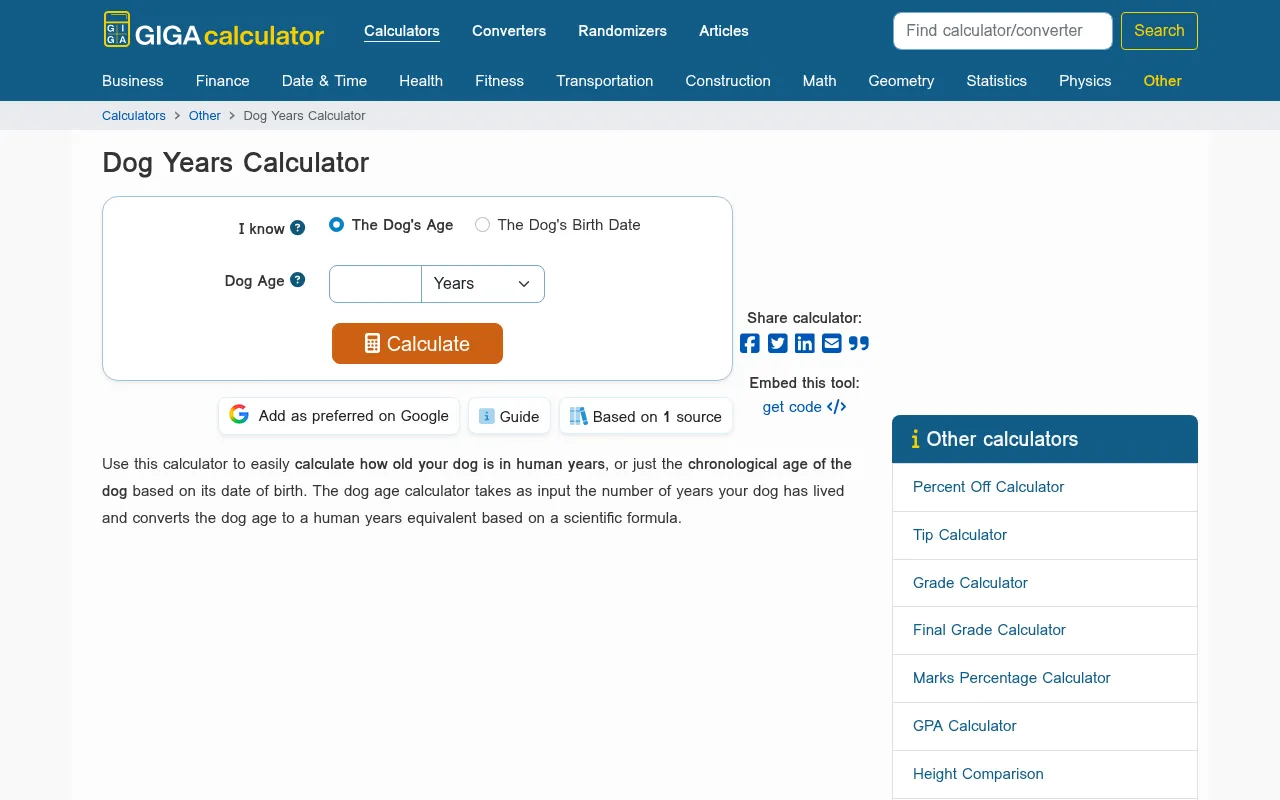
GIGAcalculator's dog years calculator is the most explicit about its source. It cites Wang et al. (2020) in Cell Systems, DOI 10.1016/j.cels.2020.06.006, derived from 104 Labrador retrievers over a 16-year age range. It is created by Georgi Georgiev and was last updated January 9, 2025.
The form is minimal: either the dog's age (years or months) or a birth date. There is no size or breed input, so every dog gets one curve. The page's own examples, 9 dog years equals 66 human and 12 equals nearly 71, match the 16 x ln(age) + 31 formula. Dogs under about 1.8 months are treated as 0.3 human years, which the page calls a rough approximation.
The page is also honest about limits. It says the formula may work for Boxers, Pitbulls and German Shepherds, and may slightly overestimate for Yorkies, Labradoodles, Maltipoos, Cockapoos, Shetland sheepdogs and Jack Russells.
The trade-off is ads. In our headless load the page showed 8 ad-slot elements and many programmatic hosts. It offers embed code if you run a site.
What we liked
- Cites the paper with a DOI
- Birth-date input
- Candid about which breeds it fits poorly
Watch out for
- One curve for every dog
- Ad-heavy
- No life stage
Best suited for
Anyone who wants the UC San Diego formula and a citation they can check. If your dog isn't a Lab-like mid-size breed, pair it with a size-based tool.
6. The Old Farmer's Almanac, best for a quick medium-dog answer from a familiar brand
The Almanac's dog age calculator has one field: the dog's age, from 1 to 16 years. Per the page, "the calculation is made for a 'medium' dog (21 to 50 pounds) using the AKC recommendation." The tool itself has no size input; a small, medium, large and giant chart sits below it. The page is written by Catherine Boeckmann and dated September 29, 2026.
Our results were medium-only: 28, 47 and 69 for ages 3, 7 and 12, which line up with Dogster's chart and Omni's Other-medium mode. If your dog is medium, that is a fine answer. If not, you have to read the chart yourself.
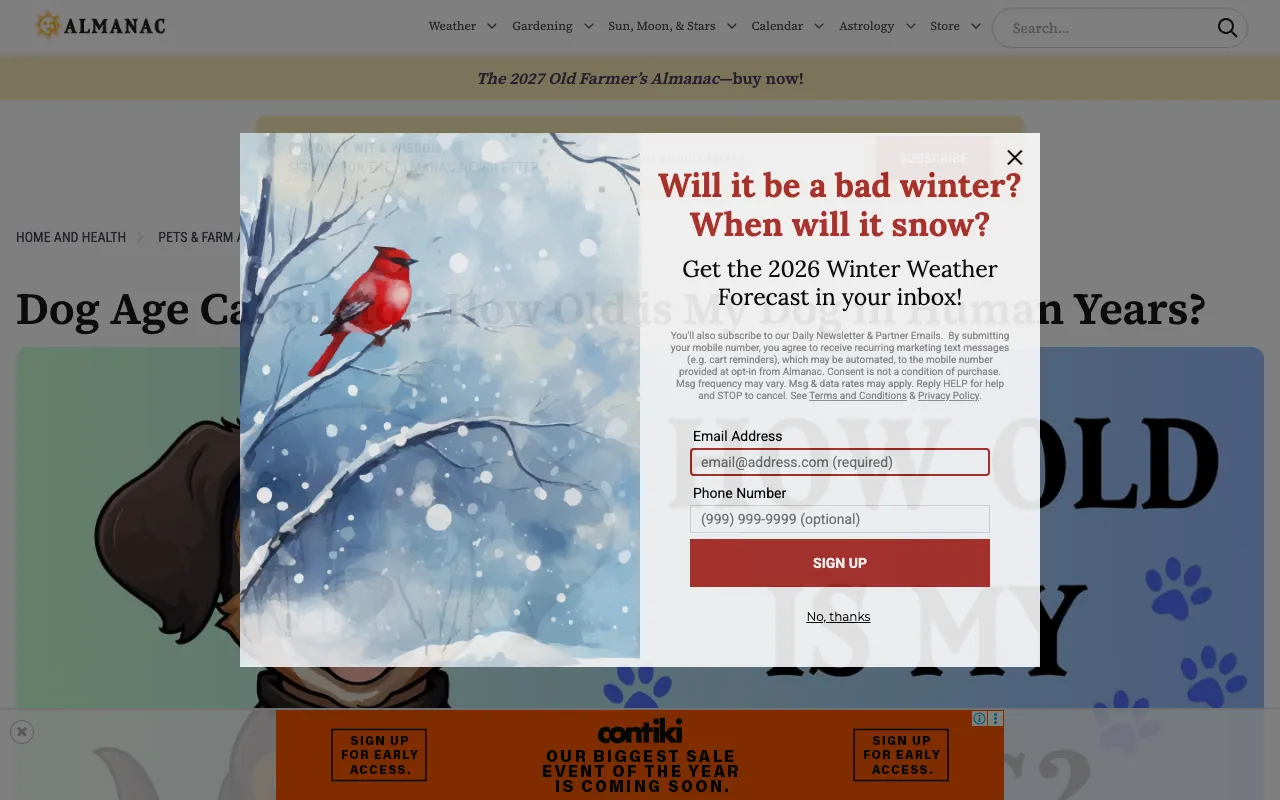
First load was the worst of the group. Our capture shows an email and phone sign-up modal over the page and a sticky banner ad, and the page references Raptive and AdThrive in its HTML, with Google, Criteo and Taboola hosts in the headless load. Our screenshot was taken with a local headless Chromium, because the screenshot service was blocked by the site.
What we liked
- Familiar publisher
- Size chart for all four classes on the page
- Very simple
Watch out for
- The tool is medium-dog only
- Ages 1 to 16 only
- Modal and the heaviest ads in our test
Best suited for
A medium-sized dog and a reader who trusts the brand. Dismiss the pop-up and use the chart if your dog isn't medium.
7. AKC "How to Calculate Dog Years to Human Years", best for the vet-association rule of thumb
The AKC article is not a calculator, and we want to be upfront about that. Its HTML title says "Dog Age Calculator," but we found no form or input on the page. You read a chart by weight and follow a link to a third-party log calculator.
What it does well is explain the numbers. It quotes the AVMA guideline: 15 human years for the first year of a medium dog, about 9 for the second, then about 5 per year. It cites the UC San Diego log formula and notes it came from a single breed and "may lack enough variables for conclusive results." It also says size matters: large dogs are often considered senior at 5 to 6 years versus about 7 for small ones. Its Great Dane example puts a 4-year-old at about 35 in human years.
The page is by AKC Staff, updated September 14, 2026, at 4 minutes to read. The raw HTML hints at Amazon and DoubleClick ad requests.

What we liked
- Trusted brand
- Explains and debunks the 7x myth
- Cites the AVMA and UC San Diego
Watch out for
- No calculator to type into
- You read a chart yourself
Best suited for
Owners who want the reasoning behind the numbers from a trusted source. Pair it with one of the calculators above for the actual figure.
Side-by-Side Comparison
We compared the six calculators and the AKC article on the criteria above: inputs, size classes, source, whether size moves the number, ad load and pop-ups. Ad counts come from headless Chromium on October 17, 2026.
| Tool | Inputs | Size classes | Source cited | Size changes number | Ad slots (headless) | Pop-up on load |
|---|---|---|---|---|---|---|
| PetName | 2 | 4 | None on page | 0 | ||
| Dogster | Up to 4 | 4 + 390+ breeds | 0 | Email banner | ||
| Omni Calculator | 2-3 | 3 | 3 classes | 1, many ad hosts | ||
| PawCalculator | 3 | 5 | Label only | Not measured | Not measured | |
| GIGAcalculator | 1-2 | 0 | DOI | 8 | ||
| Old Farmer's Almanac | 1 | 1 (medium) | "AKC recommendation" | Raptive / AdThrive | Email and phone modal | |
| AKC article | None | 4 (chart) | n/a | Ad hosts in HTML |
Which dog age calculator fits your use case
The right pick depends on your dog and what you want back. Here is how we'd match them.
| If you are... | Best pick | Why | Runner-up |
|---|---|---|---|
| Checking your large or giant dog's age quickly | PetName | Four size classes that move the number, no ads | Dogster |
| Wanting life stage, birth date and breed lookup | Dogster | Most inputs and outputs of any free tool | PawCalculator (for senior labels) |
| Owning a Labrador | Omni Calculator | Labrador mode uses the study's own formula | GIGAcalculator |
| Converting a human age into dog years | Omni Calculator | The only two-way tool we found | None on this list |
| Wanting a citation you can check | GIGAcalculator | Cites the paper with its DOI | AKC article |
| Wanting the reasoning from a trusted body | AKC article | Explains the AVMA rule and the 7x myth | Dogster |
What results look like
We typed the same ages into each tool. Three sample inputs: a 3-year-old small dog, a 7-year-old large dog and a 12-year-old giant dog. The PetName column comes from the calculator's code, which matches its unit test.
| Tool | 3 yrs, small | 7 yrs, large | 12 yrs, giant |
|---|---|---|---|
| PetName | 28 | 51.5 | 94 |
| Dogster (result box) | 28 | 54 | 99 |
| Dogster (its own chart) | 28 | 50 | 93 |
| Omni Calculator (Other mode) | 28 | 50 | No giant option |
| Omni Calculator (Labrador mode) | 49 | 62 | 71 |
| PawCalculator | 49 | 62 | 71 |
| Old Farmer's Almanac (medium only) | 28 | 47 | 69 |
| UC San Diego formula (computed) | 48.6 | 62.1 | 70.8 |
Three things stand out.
The tools split into two clusters. Size-based curves put a 7-year-old large dog between 50 and 54 (the Almanac's 47 is its medium-dog answer). The log formula and PawCalculator put every dog at 62, whether it is a toy poodle or a Great Dane.
The big gap is at the large end. For a 12-year-old giant, PetName says 94, Dogster 99 in its box and 93 in its chart, and the log tools 71. That is more than 20 years apart. The log formula was built on Labradors, so it's not an answer for a giant breed.
Small dogs agree. PetName, Dogster and Omni all give 28, 44 and 64 for a small dog at 3, 7 and 12 years.
Once you have your dog's number, see what other owners are picking for names, or browse all the free tools.
Frequently Asked Questions
Try PetName for free (no credit card required)
Most dog age calculators make you scroll past ads or sign up for a newsletter before you get a number. PetName's doesn't. You enter an age, tap a size and read the result. It takes about ten seconds. If you've just brought home a new dog, you may also want a name that fits them. Try the dog age calculator first, then generate your first batch of dog names while you're here.